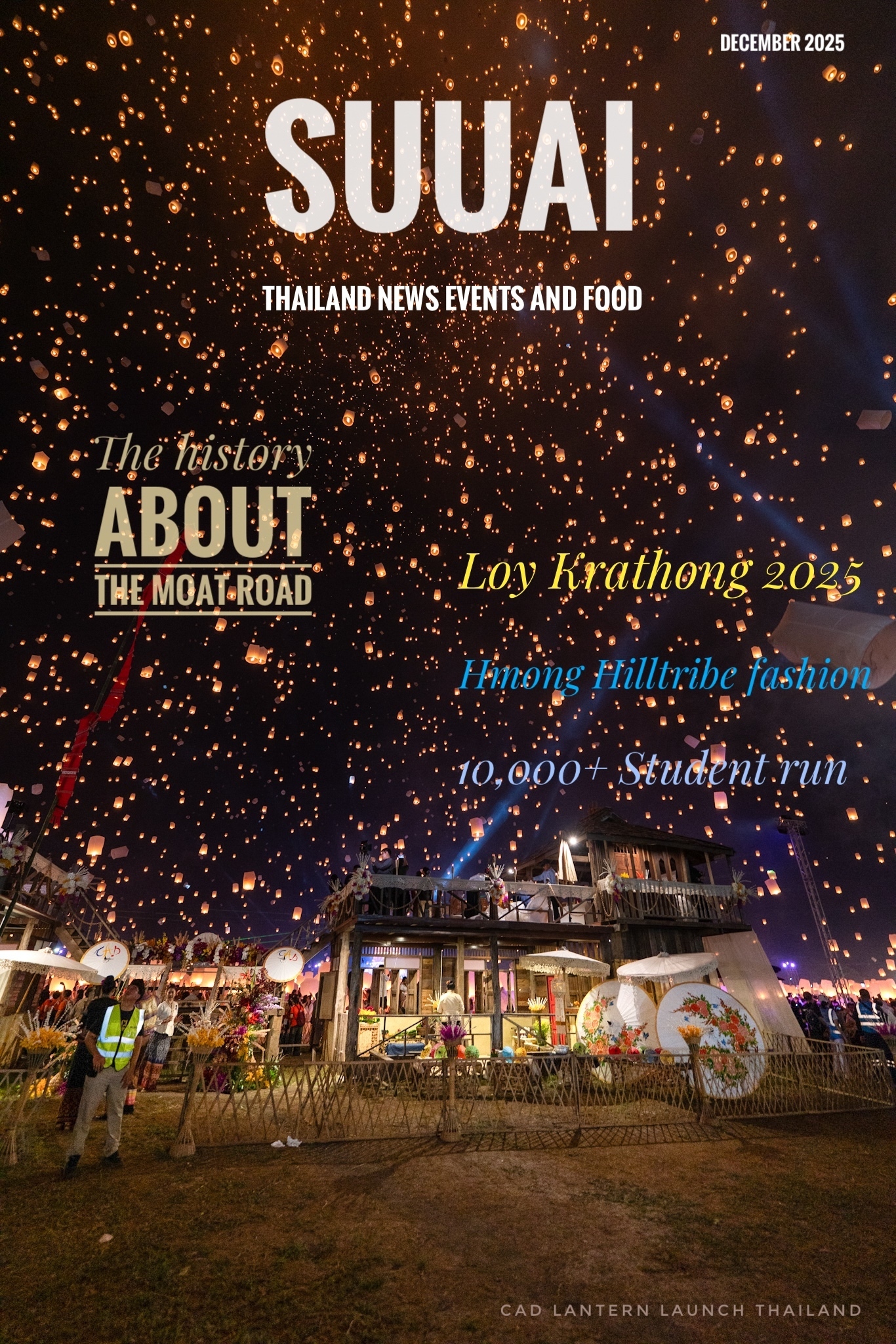
Suuai
Monthly magazine for Chiang Mai and surrounding areas of Thailand
Dec 2025
|
|
 |
| Chiang mai Thailand |
|
| A word from the editor.
Wow, what a time to be in Thailand. Events, fashion, and color everywhere you look. Chiang Mai lit up again for Loy Krathong, and the CAD mass lantern launch was a holy broccoli moment or in translation such a beautiful moment to see. More than two hundred thousand flying lanterns filling the sky. You just stand there and think, this is why we live here.
The annual parade did not disappoint either. World class fashion, cultural magic, and jaw dropping beauty the whole way through. The rain tried to challenge us, it tested everyone, go or not go, but judging by the crowds, the answer was simple. Who cares. People came anyway.
And in other news, who would have thought getting a smooth road could feel so exciting, but here we are. The moat road got a fresh layer of asphalt, clean lines, added crosswalks, the whole thing. It kinda makes one giggle smile and smirk.
Next up, Christmas is coming fast and then the new year right behind it. I hope everyone enjoys the holiday season with friends and family. Northern Thailand is alive, and this has been one of the most colorful months we have had in a long time.
Smiles, Jonky
|
|
| This is the CAD mass lantern launch for the Loy Krathong Festival just West of Chiang mai about a 30-40 minute drive. Tickets start at 4500b. Attendance 200,000. |
|
| Photo Credit: Chiang Mai Review, Nuttapong Puanpaongam. |
|
|
Something interesting is happening in Thailand, and I noticed it clearly at the Aleenta Hotel. Hospitals are now coming directly to hotels to test the employees, check their health, and make sure everything is running safely for both staff and guests. At first it sounds like something simple, just routine testing, but when you look closer, you begin to see that this is actually the start of something much bigger for medical tourism.
At Aleenta the hospital team arrived quietly, set up their equipment, and began testing the staff with the same care and professionalism you would expect inside a clinic. The hotel employees did not have to take time off or travel across town. Everything came to them. It was efficient, respectful, and surprisingly modern. It made me think that this is the beginning of a new direction for how Thailand handles both hospitality and health.
Then another thought came to me. If hospitals can come to hotels to test the staff, why not offer services to the guests as well. It turns out this idea is already taking shape. Guests are beginning to choose hotels where medical testing is available on site. Imagine staying at Aleenta, enjoying the pool and the beach, and then simply walking downstairs to have a blood test or a wellness check done without ever leaving the property. It blends health with comfort in a way that only Thailand seems to do so naturally.
This creates a whole new pathway in medical tourism. People who come to Thailand for a holiday can also take advantage of the chance to check their health. It becomes a trip that is fun and relaxing, but also useful. A guest can get a medical test while having breakfast, go for a swim after, and continue on with the day without any disruption. It is the easiest version of health care that you can imagine.
For the hotels this is a fresh selling point. Instead of only offering spa treatments or fitness classes, they can now offer real medical testing as part of the experience. For hospitals this is a direct connection to international guests who may return later for larger procedures or full checkups. And for Thailand as a country, it becomes another reason why travelers come here.
What began as hospitals testing hotel employees has now grown into a quiet transformation inside the tourism industry. It is convenient, it is smart, and it makes perfect sense. Aleenta is one of the early examples, and I would not be surprised if many other hotels begin doing the same thing.
This simple idea may end up creating a brand new chapter in medical tourism, one where hotels become the bridge between travel and health, and where guests can take care of themselves without ever leaving the comfort of their stay.
|
|
 |
|
Koh Yao Noi Thailand
Arguably one of the most beautiful beach areas in Thailand. Fly from Bangkok to Phuket for about $32, then take a shuttle boat to the island, roughly 30 to 40 minutes depending on the boat type. Hotels range from $40 to $300 a night. Notably, Cape Kudu Hotel is one of the top boutique resorts, estimated at $300 per night.
|
|
 |
| San Kamphaeng annual community festival. |
|
 |
Chiang mai
Photo credit: Jacky Tan |
|
 |
| Photo credit: Unknown. |
|
 |
| Chiang Mai city map |
|
 |
|
A Man Fighting for his Life
(Pic) new 24 hr care taker Khun Far, Tony Ives, Will Robinson. Khun Far takes over from Khun Mena who was Tony’s 24/7 care taker since March 2025. She did a sensational job taking care of Tony eating, appointments, sleep, transportation – really a remarkable story and dedicated human being. |
|
|
There are people in Thailand who do amazing work and never ask for recognition. One of them is Will Robinson. Most people know Will for his music videos, the ones that show the beauty, the culture, and the spirit of Thailand in a way that makes people want to visit this country. He has spent years creating videos ( https://youtu.be/PCiUFk6SWRE?si=rPdLj_BLm8oCXkje) bring tourists here, and he has done more for Thai tourism than most marketing campaigns ever could.
But behind the scenes, something far more personal has been happening. Will has been quietly taking care of a close friend, a man named Tony, who once served as a horse jockey for the late Queen Elizabeth of England. Tony had a bright career, a respected name, and a life many would admire. But through no fault of his own, a series of unfortunate events caused him to lose almost everything he had. Life can turn quickly, and sometimes even the strongest people can fall into hard times.
Will saw this happening and stepped in without hesitation. He did not do it for attention and he did not do it for praise. He did it because he has a good heart. He became a brother figure, making sure Tony had what he needed, including health care, a safe place to live, food, and the comfort of dignity. In a world where many people walk away from difficult problems, Will stayed.
The past year has been particularly brutal. Tony was struck with sepsis and has been fighting for his life again and again. He has faced cancer, multiple infections, and a long list of medical complications that would break most people. There have been countless hospital visits, endless medication changes, and repeated consultations with Thai doctors all over the region. And to top it all off having 3 fingers amputated to avoid the spread of infection.
These emergencies cost money, more than most people can imagine. But Will has continued to hold everything together. He searches for funds wherever he can. He talks to people who might help. He makes sure Tony receives treatment, both the routine care and the urgent care. He does everything possible to keep Tony alive and comfortable. And he does it quietly.
It is easy to say that we will take care of ourselves. Most of us believe we will never need help. But sometimes life takes a sharp turn. Illness strikes. Accidents happen. Savings disappear. And in those moments, we learn very quickly who truly stands with us.
Tony is still here today because Will Robinson did not turn away. He chose compassion. He chose loyalty. He chose to give a good man a chance to have dignity and a future. That is the kind of act that rarely gets written about, even though it should be.
Will still works on music and still promotes Thailand every day, but he carries the weight of Tony’s care on his shoulders as well. He has shown what real friendship looks like, and what real goodness can accomplish.
If there were awards for this kind of thing, Will Robinson would deserve them all. But he does not do it for awards. He does it because it is the right thing to do.
Thailand is lucky to have his creativity. Tony is lucky to have his friendship. And all of us can be reminded that kindness like this still exists in the world. https://gofund.me/b79120e28
|
|
 |
| CMU (Chiang Mai University) performing arts. |
|
 |
| Sports supporters |
|
 |
| New direct flight-
Etihad Airways from Abu Dhabi to Chiang Mai
|
|
 |
| Mark does a nice job capturing the Earthen Jar restaurant. If you haven’t tried this yet it’s well worth the visit, must order the pork belly, the chicken, and the spicy corn. |
|
|
Chiang mai RAM hospital is getting ready to open their new location in town namely RAM 2. Planned for mid Summer 2026. The hospital is said to specialize mainly in Pediatrics however they will have an ER department, but my understanding is still that for the serious type accidents and medical issues patients would be transferred to the main RAM location in town.
|
|
 |
This moment caught me completely off-guard, and somehow felt like the perfect symbol of Thailand. Who knows who the rose was meant for… a girlfriend, his mother, a teacher, a friend? But that’s the beauty of this place. Everywhere you turn, you find these small gestures of kindness. Thai warm hearts are everywhere.
|
|
 |
Memories of Chiang Mai’s Hidden Burmese Food Court
Who knew this place even existed ?! Just off the moat road, Chiang Mai’s outdoor Burmese food court (namely Memories of Chiang Mai) is one of those places you only find if someone whispers it to you. A cluster of humble food stands, each operated by families who fled Myanmar with their recipes and traditions, the court has a simple rule: no two vendors can cook the same thing.
That rule turns the entire space into a culinary treasure map.
On my latest visit, I wandered over to a stand known simply as “IL, (Iora Loikaw).” Locals speak the name like a secret. IL is famous for crafting some of the best Burmese sausages in Chiang Mai, rich, smoky, herb-packed coils that snap with flavor. But the real star of the stall is something more playful, almost impossible to define: the “bun, baby bun.”
Picture this: a small, pizza-dough-like bread, soft and fluffy. It’s filled with savory Burmese-spiced meat, a light spicy sauce, fresh cucumbers, tomatoes, and fragrant herbs that hit you with bursts of all yum. It’s familiar and foreign all at once, like a Burmese taco met a mini pizza and somehow became better than both.
Eating it in that open-air court, surrounded by the smoke of grills and the sounds of families cooking side by side, felt like stepping into the heartbeat of Chiang Mai itself. These food stalls don’t just serve meals, they preserve memories, identity, and tradition.
And IL’s “bun, baby bun”… it’s all worth the trip. https://maps.app.goo.gl/KryKPom3NQwoKRcd8?g_st=ipc
#everopendoor
|
|
|
I Love my helmet
Month Jan-Dec.
Photo credit: unknown
Unlucky rider: Unknown
|
|
 |
| Hmong Hill Tribe |
|
 |
|
What!? 75 Manholes in a mile stretch in Chiang Mai
…you’d never think anything interesting could come from staring at manholes, but in Chiang Mai you can find stories in the strangest places. I recently realized that along just one mile of the Moat Road, the square that wraps around the Old City, there are about 75 manholes. Seventy-five In one mile, the total distance around the moat is 4 miles.
Most people drive past them without ever noticing. They’re just round metal lids in the pavement. But when you stop and pay attention, they actually say something about the history of the city.
Chiang Mai was founded all the way back in 1296, and the moat wasn’t just for decoration. It was a defensive wall, a water system, and a way to manage flooding. For a city that old, everything has been built layer upon layer. What used to be ancient canals eventually became modern drainage. What used to be dirt roads became paved streets, and underneath those streets are old drainage tunnels, newer storm pipes, electric conduits, water lines, fiber-optic cables, each era adding its own connections.
Because the Old City is only one square mile, all those utilities squeeze into a tight space, and one result is this curious cluster of manholes circling the moat. They’re there because the water is still circulating, the drainage still works, and the city still relies on these access points to keep things from flooding when rainy season hits hard.
The funny part is that when you tell someone “75 manholes in one mile,” the first reaction is always the same: Is that some kind of Guinness World Record? It sounds like it could be. But it’s not, not even close. Cities like New York and Tokyo have manholes everywhere, far beyond anything Chiang Mai can compete with.
Still, that doesn’t mean Chiang Mai doesn’t get to be number one in its own way. This might be the most manholes per mile in any historic zone in Thailand. It might be the densest cluster around an active, functioning moat. It might even be the oddest blend of modern utilities running beside 700-year-old temple walls.
And that’s why something as silly and trivial as counting manholes can actually be interesting. They’re a little reminder that this city is built on layers, ancient walls, modern wiring, storm drains, and a moat that still flows the way it did centuries ago.
A lot of places have manholes. Only Chiang Mai has these manholes: sitting beside monks walking at dawn, tourists taking photos, tuk-tuks buzzing past, and a 13th-century moat quietly doing its job.
Strange trivia, maybe.
But that’s Chiang Mai, where even a manhole has a history.
|
|
|
Photo credit: Jonathan Fairfield
|
|
|
Photo credit: Mayor of Mae Sai, Khun Wannasilp Jirakas
|
|
 |
|
Hmong festival
|
|
 |
| An annual freshman students tradition run up Doi Suthep mountain in Chiang Mai, a 5 mile trek that starts at 3am. |
|
| After 10 years of rain, heat, cold, and sweat, Osprey replaced my backpack for free. Impressively durable and unbelievably long-lasting — hands down the best bag I’ve ever owned. |
|
 |
|
The New Blue Jasmine Train / Thailand
A first hand experience riding on the Blue Jasmine by Andrew Wood.
|
|
 |
|
Miss San Kamphaeng beauty contest.
|
|
|
|
|